
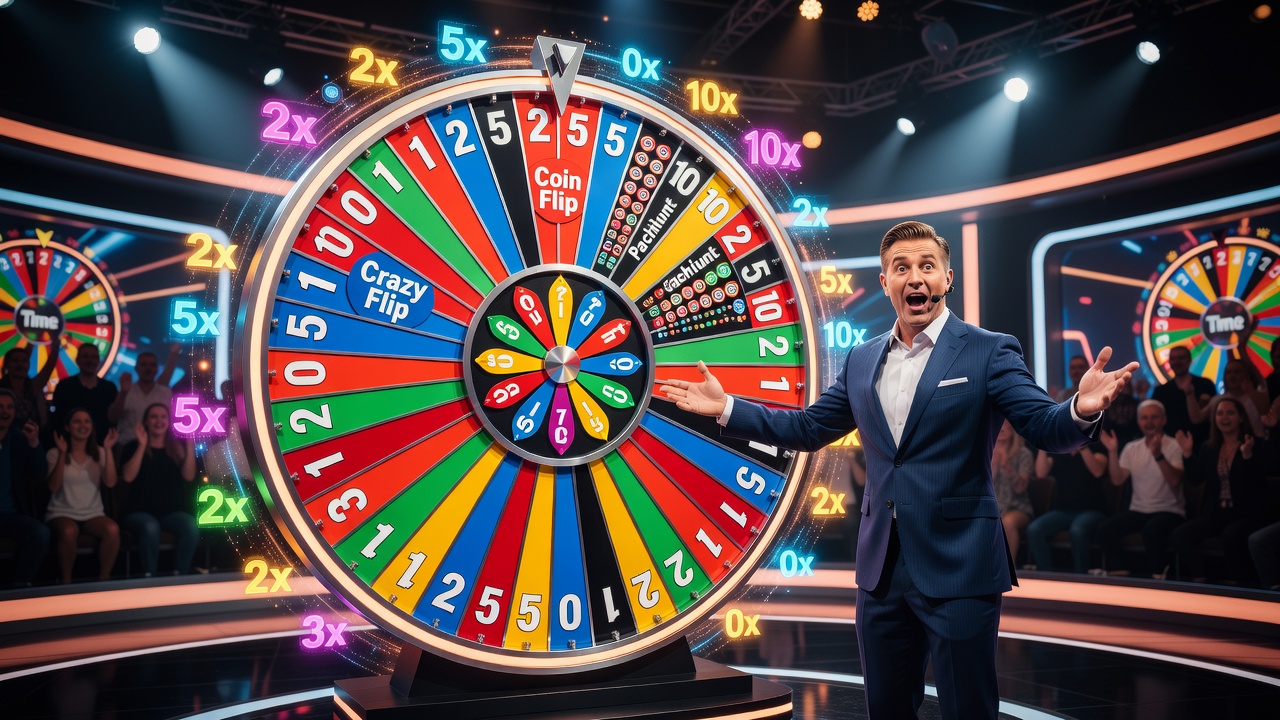
A single spin of a giant vertical wheel, split into 54 segments, decides the fate of thousands of players simultaneously. No cards are dealt, no reels are spun in isolation - everyone watching the broadcast shares the same outcome at the same moment. That format, borrowed from television game shows and rebuilt for real-money wagering, is the foundation of one of the most recognizable live casino products on the market today.
What separates this title from ordinary slot machines or table games is the presence of a live host, a physical studio, and four distinct bonus rounds that transform a simple wheel spin into a multi-layered event. Players who want to see the mechanics up close, including how the wheel segments correspond to payouts, can review a live session through crazy time a game, which shows the pacing of a typical round from bet placement to bonus resolution. Understanding that pacing matters, because the appeal of the format lies as much in its rhythm and presentation as in the payout structure itself.
This piece breaks down the mechanics behind the wheel, the betting options available before each spin, the four bonus games that give the format its identity, and the practical considerations that separate an informed player from someone simply reacting to flashing graphics.
What Is the Crazy Time Live Game and Why It Stands Out
The crazy time live game belongs to a category often called live game shows - a hybrid between a traditional casino wheel game and broadcast entertainment. Unlike a slot machine that generates results through a random number generator hidden inside software, this format uses a physical wheel spun in a studio, filmed and streamed to players in real time. The randomness is verifiable because viewers watch the wheel stop, rather than trusting an invisible algorithm.
Origins in Live Dealer Gaming
Live dealer gaming emerged as operators tried to replicate the atmosphere of a physical casino floor for remote players. Blackjack and roulette were the first titles to make that transition. The wheel-based game show format extended the concept further, adding presenters, sound design, and augmented reality graphics that overlay onto the physical set during bonus rounds.
Why Players Are Drawn to This Format
The appeal comes from unpredictability paired with spectacle. A standard wheel spin might pay out at a modest multiplier, but the four bonus segments introduce the possibility of payouts reaching far higher multiples of the original stake. That volatility, combined with the social atmosphere of a shared live broadcast, creates a viewing experience closer to a game show than a conventional casino round.
How It Differs From Traditional Table Games
Traditional table games like blackjack or baccarat rely on strategy and card knowledge. This format requires no skill in the traditional sense - outcomes depend entirely on where the wheel stops and how bonus rounds unfold. That accessibility is part of why it has drawn players who might otherwise avoid games requiring memorized strategy.
Understanding the Crazy Time Casino Game Wheel and Segments
The wheel itself contains 54 segments, each representing a possible outcome. Most segments correspond to number values - 1, 2, 5, and 10 - which pay out according to the number staked and where the wheel lands. The remaining segments trigger one of the four bonus games, each with its own visual theme and payout mechanism.
Number Segments and Their Frequency
The number 1 appears most frequently on the wheel, followed by 2, then 5, then 10. This distribution means smaller, more frequent wins are balanced against rarer, larger multiplier segments. Betting on the number 1 statistically produces wins more often, but at a lower payout ratio than betting on 10, which triggers less frequently but pays substantially more when it does.
Bonus Segment Placement
Four bonus segments are interspersed among the number segments: Coin Flip, Cash Hunt, Pachinko, and Crazy Time itself. Each appears a limited number of times out of the 54 total segments, making them rarer than standard number outcomes but central to the game's identity and its potential for high multipliers.
How the Physical Wheel Ensures Fair Outcomes
Because the wheel is a physical object filmed in real time, the mechanism for stopping it is engineered to produce outcomes with verifiable randomness, typically audited by independent testing organizations that review live casino equipment for fairness. This distinguishes the format from digital-only games where randomness must be trusted rather than observed.
- Number 1: appears most frequently, lowest payout multiplier
- Number 2: second most frequent, moderate payout
- Number 5: less frequent, higher payout
- Number 10: rarest number segment, highest number-based payout
- Bonus segments: Coin Flip, Cash Hunt, Pachinko, Crazy Time
How the Crazy Time Game Show Format Works in Practice
A live host manages the studio floor for every round, announcing betting windows, spinning the wheel, and narrating bonus round outcomes. The presentation borrows heavily from television game show conventions - dramatic pauses, audience-style reactions built into the broadcast, and a countdown clock that tells players exactly how long they have to place wagers before the wheel locks.
The Role of the Live Host
The host does more than spin the wheel. During bonus rounds, particularly Cash Hunt and Pachinko, the host's actions directly influence the outcome sequence players see unfold, adding a layer of unpredictability that a purely automated game could not replicate.
Betting Windows and Timing
Each round follows a strict sequence: a betting window opens, players select their stakes across one or more segments, the window closes, and the wheel spins. This entire cycle typically takes under a minute for standard rounds, though bonus rounds extend the timeline considerably as the host walks through the additional mechanics on screen.
Visual and Audio Production Elements
Augmented reality graphics overlay directly onto the studio set during bonus games, transforming a static wheel-spinning environment into an animated sequence with dynamic multipliers, flashing numbers, and thematic sound cues. This production layer is what pushes the format closer to entertainment television than to a conventional casino floor.
Playing the Crazy Time Online Game: Rules, Bets, and Interface
Accessing the crazy time online game requires an account with an operator that carries the live casino product, since it streams from a dedicated studio rather than running as a downloadable or locally rendered application. The interface displays the live video feed alongside a betting panel where players select chip values and place stakes on one or more segments simultaneously.
Placing Bets Before Each Spin
Players are not restricted to a single bet per round. It is common to spread stakes across multiple number segments and one or more bonus segments, balancing frequent smaller wins against the chance of a large bonus round payout. The interface displays potential payouts in real time as bets are adjusted.
Minimum and Maximum Stakes
Stake limits vary by operator, but the structure typically allows very small minimum bets, making the format accessible to casual players, while maximum limits accommodate higher-stakes participants. This flexibility is part of why the game show format has drawn a wide range of players rather than a narrow high-roller audience.
Reading the Multiplier Display
A running multiplier appears on screen throughout bonus rounds, updating as the sequence progresses. Understanding how to read this display - and recognizing when a multiplier is locked in versus still in play - is essential for players tracking their potential returns during a live round.
The Four Crazy Time Bonus Game Rounds Explained
The bonus rounds are what elevate this title above a simple wheel game. Each of the four - Coin Flip, Cash Hunt, Pachinko, and Crazy Time - operates on distinct mechanics, and understanding each one separately clarifies why the format generates such variance in potential payouts.
Coin Flip
Coin Flip is the simplest of the four. A double-sided coin, red on one side and blue on the other, is flipped on screen, with each side carrying its own multiplier value. Whichever side lands face up determines the payout multiplier applied to bets placed on this segment.
Cash Hunt
Cash Hunt presents a grid of symbols, each hiding a multiplier value. Players select one symbol before the host uses a targeting mechanism to reveal a randomly chosen symbol from the grid, awarding the multiplier hidden beneath it. This round tends to produce a wide range of outcomes since the grid contains dozens of hidden values.
Pachinko
Modeled on the Japanese arcade game of the same name, this round involves a ball dropped through a pegged board, bouncing unpredictably before settling into a slot at the bottom. Each slot corresponds to a multiplier, and one slot carries a special doubling feature that can significantly increase the final payout.
Crazy Time
The flagship bonus round places players inside a virtual environment with four colored flappers, each representing a different multiplier range. After selecting a flapper, a large wheel spins to determine the outcome, and the environment can trigger a top-up feature that increases the multiplier further before the round concludes. This round carries the highest potential multipliers in the entire format.
Strategy, Risk Management, and Responsible Play
No amount of study changes the fundamentally random nature of where the wheel stops. What players can control is how they allocate stakes and how they manage their bankroll across a session, since the format's volatility means losing streaks on number segments are common even for players who eventually hit a bonus round.
Balancing Frequent Bets with Bonus Segment Wagers
A common approach involves placing the bulk of a stake on the number 1, which appears most often, while allocating a smaller portion to one or more bonus segments. This spreads risk across frequent, smaller returns and rarer, larger ones, rather than concentrating everything on a single outcome type.
Setting Session Limits
Because rounds move quickly and bonus segments can produce dramatic swings in balance, setting a fixed loss limit and a target win threshold before starting a session helps prevent decisions driven by momentary excitement rather than planning.
Recognizing Variance Over Short Sessions
Short sessions are particularly vulnerable to variance. A player might sit through a dozen rounds without a single bonus segment appearing, simply because those segments occupy a smaller share of the wheel. Recognizing this as normal variance, rather than a sign the game is unfair, is central to playing with realistic expectations.
Questions and Answers
Is the crazy time live game rigged in any way?
The wheel is a physical object filmed in real time, and reputable operators subject their live casino equipment to independent auditing for fairness. Outcomes depend on the physics of the spin rather than a hidden algorithm, which is part of why the format is trusted by regulated operators.
How long does a typical round last?
Standard rounds without a bonus trigger usually complete within a minute, covering the betting window and wheel spin. Rounds that land on a bonus segment take considerably longer, often several minutes, since the host walks through the full bonus mechanic on screen.
Can I play the bonus games without betting on them directly?
No. Payouts from bonus rounds only apply to players who placed a bet on that specific segment before the wheel stopped. Betting only on number segments means bonus round outcomes will not affect your balance, even if you watch them unfold.
Which bonus round has historically offered the highest multipliers?
Crazy Time itself, the flagship round, carries the highest ceiling among the four bonus games due to its top-up feature and flapper selection mechanic. Coin Flip tends to produce the most modest range by comparison, since its mechanic is simpler.
Do I need special software to access this game?
No separate download is required. The crazy time online game streams directly through a browser or app interface provided by the operator carrying the live casino product, similar to how other live dealer games are accessed.
Why do number segments pay differently even though they're on the same wheel?
Payout size is inversely related to frequency. Numbers that occupy more segments on the wheel, like 1, appear more often and therefore pay less per win, while rarer numbers like 10 pay more precisely because they appear less frequently across the wheel's 54 segments.